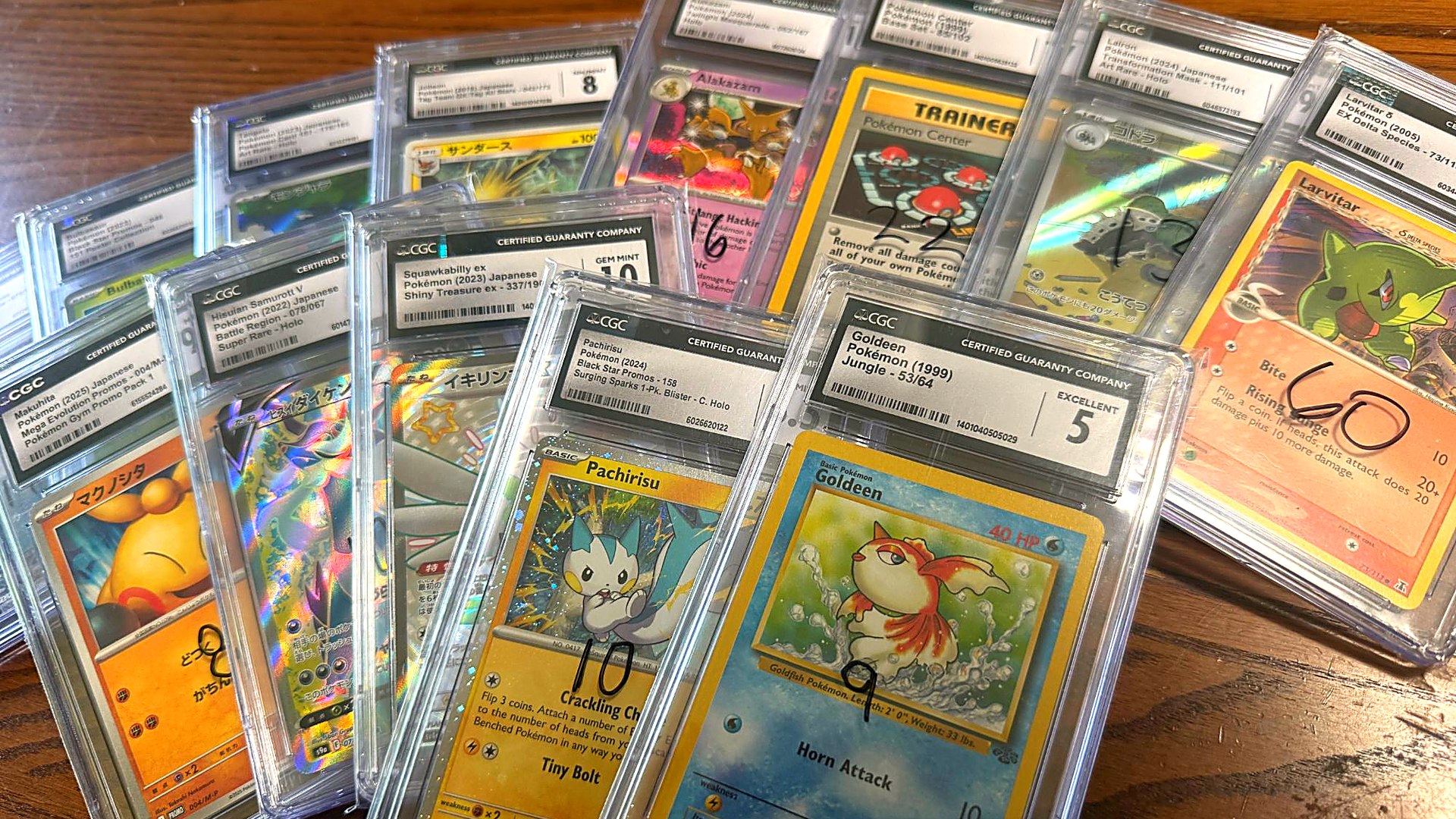
You walk the show floor with a stack of slabs — some CGC, a few PSA 8s and 9s — and table after table either passes, shrugs, or offers you a fraction of what you expected. It's frustrating, and it makes you wonder if there's something wrong with your cards.
There usually isn't. What you're running into is a liquidity problem, not a value problem — these cards are harder for a vendor to resell quickly, so they're careful about buying them. This guide is how to sell your CGC slabs and mid-grade cards without giving them away: why they keep getting passed on, what they're really worth, and every real option for moving them.
CGC slabs and mid-grade PSA 7/8/9 cards get passed on at shows because of liquidity, not value — they're harder for a vendor to resell fast. To actually sell them: for a few higher-value cards, eBay reaches the most buyers; to clear a whole stack with the least hassle, sell the lot to a bulk buyer (one price, no fees, no shipping). Below: why they're hard to move, what they're really worth, and every option — including selling locally in Hawaii with no shipping.
Why vendors keep passing on your slabs
A vendor at a show isn't a collector buying what they love — they're a business buying what they can resell for a profit, fast. Every card they buy has to clear two bars:
- Can they mark it up? They need to buy below what they can sell it for.
- Will it move? Cash tied up in a slow-selling slab is cash they can't flip into the next deal.
Cards that fail either bar get passed on — not because they're bad, but because they don't fit that vendor's business. Add in that vendors have limited cash and limited table space at any given show, and they naturally cherry-pick the fast, liquid stuff (gem-mint moderns, hot rookies, raw vintage, sealed) and skip the rest. Your slab might genuinely be worth something — it's just not worth it to them, that day.
The mid-grade "dead zone," explained
Here's the hard truth about PSA 7s, 8s, and most 9s on modern cards: they often sit in a no-man's-land.
- The premium money is in the 10 (and sometimes 9.5s on other scales). A PSA 10 can sell for several times what the same card in a 9 does.
- Buyers who want that card badly want the 10 for the top-grade premium — or they want it raw and cheap so they can try to grade it themselves and hit the 10.
- That leaves the 8 and 9 stuck in the middle: not high enough to command the premium, not cheap enough to be a bargain. On a lot of modern cards, a graded 8 is worth barely more than the raw card — sometimes less than what you paid to grade it.
It helps to understand how grading's goalposts moved. On vintage, grading does two honest jobs: it seals and protects the card, and it tells you and the buyer exactly what condition it's in — a 7 is a perfectly respectable, sellable grade. But the modern grading boom rewrote the scoring: on new cards it's 10 or bust. Because gem-mint copies are everywhere, anything short of a 10 reads as a failed attempt — which is exactly why you'll hear a vendor shrug and say "I'll just crack it and sell it raw." That's an option for you as the seller too. The catch: with PSA's fees climbing seemingly by the day, cracking a slab you already paid to grade can feel like throwing money away.
A caveat by category: that "10 or bust" rule bites hardest in modern Pokemon, where print quality is high and gem-mint copies are plentiful. In sports, print quality is often rougher, so true 10s are genuinely harder to come by — which means a PSA 9 is frequently a very respectable, liquid grade on a sports card, not a "failed 10."
(Important exception: genuine vintage. A PSA 7 on a truly old or scarce card can be very desirable, because high grades barely exist. The dead-zone problem is mostly a modern issue, where gem-mint copies are plentiful.)
None of this means your card is worthless — it means the grade didn't unlock the premium you were hoping for, which is a very common and very fixable misunderstanding.
What slab it's in: a grading-company breakdown
The label on the holder changes how easily a card sells, and for how much. Here's the honest state of each company and what it means when you're the one selling.
- PSA — the gold standard. The most liquid label across the board and the one most buyers trust and chase. In Pokemon especially, PSA is king — a PSA slab tends to move faster and for more than the same card in any other holder. If you're deciding where to submit, PSA is the safe resale bet.
- CGC — strong work, but a Pokemon sticking point. In sports it sits comfortably alongside SGC and BGS, with no real stigma. The "PSA over CGC" bias people talk about is mostly a Pokemon dynamic: PSA so dominates that market that CGC slabs often sell for less, and buyers (and repackers) lean PSA. A CGC slab is far more of a problem in Pokemon than it is in sports.
- SGC — the vintage sports favorite. Well-respected and fast for older sports cards, with a clean look. Less common on modern or TCG, but a non-issue to sell in its lane.
- BGS (Beckett) — familiar on vintage, with a catch. It carries a reputation for softer grading standards on older cards, so buyers are warier of paying full price — the same card might grade lower elsewhere. That hesitation means more work convincing a buyer, and often a discount to move it.
- TAG — newest, thinnest market. Its tech-driven grading has real fans, and certain regions and pockets have genuine demand for it. But liquidity is thin overall: the big repackers don't buy TAG, and when the largest buyers sit out a label, it drags liquidity down across the board. Great grades, harder exits.
The takeaway: PSA is the most liquid, so if you're submitting, it's the safe call — but you don't always get to be picky. If you're holding a numbered card or a short-print (SSP) in sports, buyers can't demand it be in PSA; scarce cards sell in whatever slab they're in, because there may not be another copy out there. The label matters most on common, high-pop cards where the buyer has options, and least on the stuff nobody else has.
What your cards are actually worth
Before you sell anything, anchor to reality:
- Look up your own grade — and don't get hung up on the 10. The gem-mint price is a different market; it tells you almost nothing about what your 8 or 9 brings. Check recent sold prices (not asking prices) for your exact card, grade, and grader. eBay's sold-listing history is the fastest real-world gauge.
- Expect volatility, and price for the downside. High-pop cards swing hard — the same card can sell for $60 and $90 on the same day. Because that downside is real and buyers know it, you'll have a hard time getting anyone to pay the top of that range at "market." If you actually want it to move, anchor to the middle-to-lower end of recent sales, not the best comp you can find.
- Crossing over or regrading (cracking a slab to resubmit, or chasing a grade bump) is usually not worth it on mid-grade cards — you pay fees again and gamble on the result. Occasionally worth it on a high-value card with a big grade-to-grade jump; rarely on the stack you're trying to clear.
Knowing the real number protects you from both underselling and from holding out for a price that isn't coming.
The best ways to sell mid-grade & CGC slabs
No single option is "best" — it depends on how much each card is worth and how much work you want to do.
eBay — for the patient. The widest audience, but it rewards patience. Singles and PSA 10s move best, and a 9 with regrade potential can do well too. The trade-off is real: seller fees (~13%) plus the hours you put into listing, photographing, packing, and fielding offers. Worth it for higher-value individual cards; for a pile of mid-grade, the time adds up fast.
Whatnot — great platform, tough from a standing start. Whatnot is a great place to sell live — but if you're starting from scratch with no followers or sales history, you'll hit liquidity problems early, and depending on how you run your auctions you can end up selling well under market just to move things. Much better once you've built an audience; rough on day one.
Consign through a local show or vendor. Not ready to run your own listings? Go to shows in your area and ask around — some vendors will consign for you, selling your cards on their table or platform for a cut. You lean on their audience and reputation instead of building your own from zero.
TCGplayer — mostly for singles. Built for TCG, and in practice it's mainly a singles market — a better fit if you've got Pokemon or Magic raw singles than if you're moving slabs.
Facebook Marketplace / groups — free, with a tax. A solid alternative to the established platforms, with no seller fees — as long as you're willing to put up with the handful of fake or flaky buyers who'll waste your time before a real one shows up.
Card shops — convenience, priced in. A shop will almost always make you an offer — but for them it's about what their time and money are worth. If they can take it in cheap, they will; your payout is essentially paying for the convenience of having someone there to cash you out whenever you walk in. Fast and certain, rarely top dollar.
A bulk buyer / dealer — the whole lot, gone. This is usually the least painful path, especially for a big stack. Instead of listing cards one by one, you sell the entire lot to someone who wholesales — one conversation, one price, no fees, no shipping, no waiting. We've got contacts with buyers who'll take the whole lot off your hands, no questions asked — more on that just below.
The honest downside of doing it yourself
Here's what the list above doesn't show: the work. Selling mid-grade and CGC slabs yourself means photographing each card, writing listings, pricing against comps, answering lowball offers, packing and shipping safely, eating the fees, and chasing the occasional no-show or return. For a few high-value cards, that effort pays off. For a stack of $5–$30 slabs, the time can cost more than the cards are worth. That's the real reason these pile up in people's closets.
The easy button
If that sounds like more trouble than it's worth — honestly, it often is — you don't have to do it alone.
If you're looking to sell cards like these, we can help. Send us a quick list (or just photos) of what you've got, and we'll point you toward the right buyer for it — and if you'd rather skip the whole process entirely, our buyers can make you a no-pressure offer on the lot. No fees, no shipping, no sitting on it for months.
📩 Email us about selling your cards[email protected] — tell us roughly what you have, and we'll take it from there. Especially easy here in Hawaii, where you can skip shipping entirely.